Imagine opening your next NHS pension statement and seeing a minus sign next to your 1995 or 2008 NHS pension. Has something gone wrong? Have you lost money? The answer is no, and here’s the silver lining – it might even trim your annual allowance bill a little. Here’s what’s going on, in plain English.
At a glance
- Your legacy 1995 or 2008 pension hasn’t gone down – it’s still rising with your pay.
- But this year, inflation (3.8%) ran slightly ahead of the doctors’ pay award (3.5%).
- Because of how the tax rules measure “growth”, that small gap can show up as a negative number.
- It can reduce your total NHS pension growth.
- It does mean that part of your pension may not have kept up with inflation.
A race between your pay and inflation
Each year, the tax rules ask one question: did your pension grow by more than inflation? Only growth above inflation counts towards your annual allowance, the £60,000 you can build up in pensions before tax is due each year.
Your 1995 and 2008 benefits stopped building up new years of service in 2022, but if you are still working in the NHS, they remain linked to your pay. So this year it comes down to a simple race.
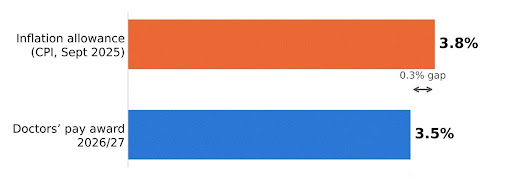 Inflation figure: CPI for September 2025 (ONS). Pay award: 2026/27 award for doctors in England.
If your pay rose by the 3.5% award, your legacy pension lost the race by a nose – and the tax rules record that as negative growth.
How “growth” is worked out
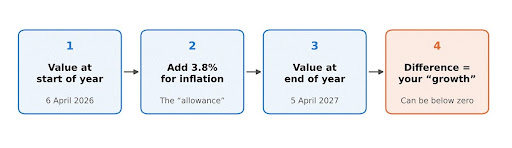
The key step is number 2. Before comparing your start and end values, NHS Pensions adds an inflation allowance. If your pension rose by less than that allowance, the difference is a minus figure. In real terms, your pension has still gone up in pounds and pence; it simply hasn’t kept pace with inflation.
So does it cut my tax bill?
A little. Since 2023/24, a negative figure in your 1995/2008 pension can be set against growth in your 2015 scheme pension in the same year. But the 2015 scheme is growing quickly; it was increased by 5.3% in April 2026, and you build up a new slice of pension every year, so the negative figure tends to be small by comparison.
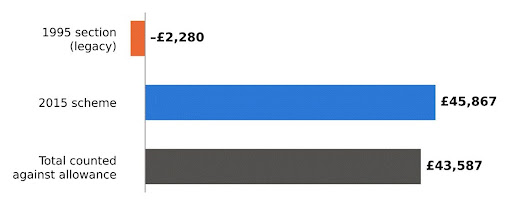 Illustration only – not a real client. Assumes a 1995 section pension of £40,000 plus lump sum, a 2015 scheme pension of £25,000 and 2015 pensionable pay of £134,550, with pay rising by the 3.5% award and nothing else.
In this example, the legacy pension trims about £2,300 off total growth of more than £45,000. Helpful – but if you were expecting an annual allowance charge, it’s unlikely to make it disappear on its own.
Three catches to know about
- It only counts in the same tax year – you can’t save it for later years.
- It can only reduce growth in your 2015 NHS pension – not in a SIPP, personal pension or the NHS AVC scheme.
- It doesn’t give you extra unused allowance to carry forward.
Is this you?
Will it happen again next year?
Not necessarily. This is a timing quirk, not a permanent feature. The inflation figure for 2027/28 is 3.5% (September 2026), so it will depend on next year’s pay award. If you receive a Pension Savings Statement for 2026/27, it is due by 06 October 2027.
Three things to do now
- Don’t assume a minus figure means no tax charge. Your 2015 scheme growth still counts, and it’s usually the bigger number.
- Keep your payslips and Total Reward Statements. Changes to salaries, increments or awards can turn a negative into a positive – and they make your figures much easier to check.
- Check whether the tapered allowance applies to you. Higher earners can have an allowance well below £60,000, so every pound of growth matters more.
Want to know where you stand?
We help NHS doctors make sense of their pension statements and annual allowance position every day. If you’d like us to look at your 2026/27 figures, get in touch with your adviser.
We explain negative pension figures in more detail in our earlier article, “NHS pension statement: negative inputs explained”, and what to do when your statement lands in “Has your NHS Pension Savings Statement arrived? What you need to do now”.
This article is for general information only and is not personal advice. Tax treatment depends on individual circumstances and may change. Figures are based on our understanding of the rules and published rates at 27 October 2026.
Figures and sources used:
- CPI 3.8% (September 2025) – ONS, Consumer price inflation, UK: September 2025.
- CPI 3.5% (September 2026) – ONS, Consumer price inflation, UK: September 2026, released 21/10/2026.
- Pay award 3.5% for Hospital and Community Health Service doctors and GP contract pay elements (England) – Written Ministerial Statement HCWS1462, 25/03/2026.
- Resident doctors’ rises of 3.5%–7.1% by pay point from 01/04/2026 – BMA summary of the June 2026 offer, accepted 29/06/2026
- 2015 scheme revaluation 5.3% (CPI 3.8% + 1.5%) – SPPA circular 2026/02 under the Public Service Pensions Revaluation Order 2026. SPPA covers Scotland; the Revaluation Order is UK-wide, but confirm against an NHSBSA (England and Wales) source.
- Offset of negative legacy input against the reformed scheme from 2023/24 – Finance Act 2004 (Registered Pension Schemes and Annual Allowance Charge) Order 2024 (SI 2024/357), new s.236ZA FA 2004.
- https://hscpensions.hscni.net/wp-content/uploads/2024/09/Negative-PIA-Factsheet.2.pdf