At a glance, the third quarter was choppy: markets were slightly positive in the UK and US, flat in Europe, and negative in Japan and China. Bond yields rose as central banks weighed inflation and the Fed hiked rates. Against this backdrop, our portfolios remain underweight in US tech, with shorter-dated bonds as a buffer against volatility.
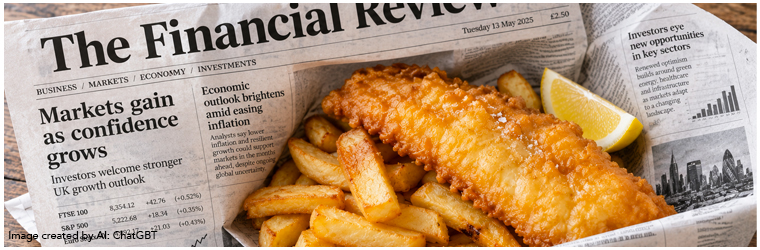
Today’s headlines, tomorrow’s chip paper
When was the last time you had takeaway fish and chips? If you did, it was most likely handed over in a cardboard box, wrapped in plain paper, or, worse still, served in a styrofoam container.
I’m just about old enough to remember getting my fish and chips wrapped in newspaper. How things have changed: few people read newspapers these days! And there’s the old adage that news goes out of date very quickly: “today’s newspaper is tomorrow’s chip paper”. That has never been truer when you consider some of the headlines we’ve seen on geopolitical and market events over the last few months, and their reported impact…
“Stocks gain, oil slides as Trump says Iran deal signed” Reuters, 15 June 2026
“Oil settles up over $2 as Iran war stalemate stokes supply concerns” Reuters, 17 August 2026
“S&P 500 closes higher to start October as Treasury yields retreat ” CNBC, 1 October 2026
“Wall St banks caught in capital markets lull after a strong first half of 2026” Reuters, 15 October 2026
The third quarter of 2026 was something of a see-saw quarter, although we must remember that investing is a long-term game!
Much of the movement has been driven by sentiment, primarily hope and fear, as headlines have chopped and changed between a reported end to the Middle East standoff and new acts of aggression: from the war is over to… no, it isn’t.
After a very strong second quarter, markets proved choppy in the third. Global stocks slipped in July but broadly rose in August on the back of stronger corporate earnings across regions. Technology and Artificial Intelligence (AI) related stocks rallied after a sharp sell-off in July. Cloud revenues helped Microsoft and Amazon report better-than-expected growth, and chip giant Nvidia posted record-breaking quarterly revenues of $96bn, more than double the same period last year.
Markets have been fairly consistent – consistently volatile, that is. Following the July sell-off and August bounce, they fell slightly again in September. Overall, the picture for the quarter varied by region: slightly positive in the UK and US, flat in Europe, and negative in Japan and China.
Equities – a mixed bag
The table below illustrates how much of the return on global equities has been driven by growth in the second quarter.
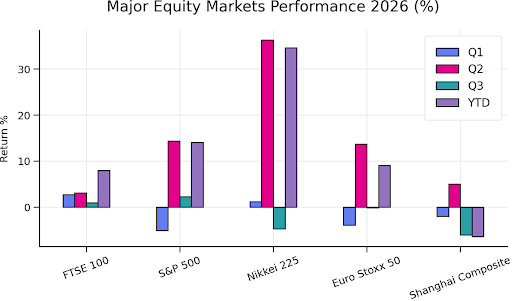
Source summary: quarterly and YTD returns compiled from publicly available market-performance datasets current to October 2026.
The tech sector experienced some meaningful swings as investors grappled with whether the large capital expenditure poured into these businesses will ultimately pay off in terms of the revenue it is expected to generate. Some AI and tech giants are moving from being free cash flow positive to free cash flow negative: they are now going through more cash than they earn because of continued, substantial investment in AI infrastructure.
The ‘existential threat from superintelligent AI’ has finally entered the mainstream conversation. A “pause” by leading US AI firms could have a big impact on their growth prospects, and on those integral to the AI supply chain.
Some equity regions posted modest gains over the quarter, although it is interesting to note that UK and European smaller companies did better than some of the larger stocks.
This small company growth appears to have been driven by a combination of factors. The last quarter coincided with a solid UK reporting season, with many FTSE 250 and Alternative Investment Market (AIM) companies delivering better-than-expected results. UK smaller companies had been trading at historically depressed valuations relative to larger listed companies, and both domestic and international investors appear to have been rotating into ‘cheaper’, more domestically oriented stocks.
Bonds/Fixed Income – Inflation worries having some impact
Bond markets were mixed over the quarter, and returns were generally negative, especially on longer-dated bonds. Shorter-dated bonds (typically 2 to 5 years’ duration) were much less impacted, as they are less sensitive to central bank interest rate moves. They also make up a significant part of bond holdings within Legal & Medical’s portfolios, which has helped dampen volatility.
Across the bond sector, all eyes have been on central banks, which continue to weigh higher inflation (not helped by the conflict in the Middle East and $100+/barrel oil prices), uncertainty over fiscal policy, and macroeconomic growth.
UK: The Bank of England (BoE) kept interest rates unchanged at 3.75%. However, three of the nine members had voted to increase rates by 0.25%, noting that inflation has remained above target for several years.
US: The Fed hiked rates, with new Fed Chairman Kevin Warsh noting in his keynote Jackson Hole Symposium speech that inflation data has not meaningfully improved. Further hikes remain a real possibility unless the Middle East situation is resolved.
Bond yields (the interest rates that governments worldwide pay to service their debts) have risen as markets anticipate further central bank action. By way of example, the interest rate yield on 10-year US Treasuries rose from 4.5% to 5.2% over the quarter*, and in a similar vein, 10-year UK Gilts rose from 4.8% to 5.4% over the same period*.
The global economy has remained resilient despite higher borrowing costs. Labour markets remain relatively strong across major developed economies, and inflation, although it has ticked up, remains well below previous years. Central banks are balancing the need to control inflation against the need to support economic growth.
For investors, bonds offer attractive income opportunities and can help diversify portfolios during periods of stock market volatility. Maintaining a diversified portfolio remains a sensible long-term approach.
*source CNBC
Alternatives – remain a useful diversifier
Commodities generated outsized returns over the quarter, led by precious metals and energy indices. Gold has been broadly supported by dollar weakness and central bank purchases, while energy commodities have continued to advance as the Middle East backdrop remains tense.
Summary
Overall, equity markets have remained resolute. The exceptions were Japan and China, which gave up some gains, especially Japan after a spectacular second quarter. Elsewhere, investors focused on positive corporate earnings and continued growth driven by AI buildout.
That said, significant uncertainties remain around geopolitical conflicts and the impact on inflation and global growth. The uncertainty over how AI will shape markets and economies is also growing rapidly. In this environment, we believe maintaining a diversified portfolio that targets good fundamentals and valuation-based opportunities remains prudent.
Legal & Medical Portfolio Positioning
We remain somewhat underweight in US stocks, and tech stocks in particular. In the September rebalance, overall equity exposure was broadly unchanged, but we again rotated some funds from the US to other global markets, including the UK and Japan, where we see better value. We also added a new fixed income fund to the portfolios.
In the Bonds, we continue to hold a higher proportion of shorter-dated holdings, which are much less susceptible to inflation and potential interest-rate changes. We plan to continue in this vein to provide a counterbalance to equity market risk.
Whilst risk to the downside always remains, the portfolios are constructed to weather it while capturing the upside. Our portfolios continue to hold a good mix of asset classes, taking a diversified approach to smooth the investment journey for investors.
Equities: holdings in the portfolios are designed to deliver long-term growth.
Fixed income: holdings focus on high-quality businesses and shorter maturities, offering an attractive level of return with lower risk.
Alternatives: assets such as infrastructure and commodities (including gold and silver) provide additional diversification through exposure to steady long-term cash flows, which reflect the effects of economic growth and inflation.
If you have any concerns, or you would like to discuss your portfolio with your specialist financial adviser, do get in touch in the usual way. We are here to help.
The concepts and suggestions in this article must not be viewed as advice. As always, we recommend you approach a Financial Adviser who will take your circumstances into full consideration before providing advice.