I had an interesting chat with my teenage daughter, following the appointment of Andy Burnham as our latest Prime Minister. We were discussing how many UK Prime Ministers have held office in her lifetime. She was born in 2009, not that she remembers the last year of the Gordon Brown administration, but from Brown through to Burnham we reckoned on 8 in a little over 16 years.
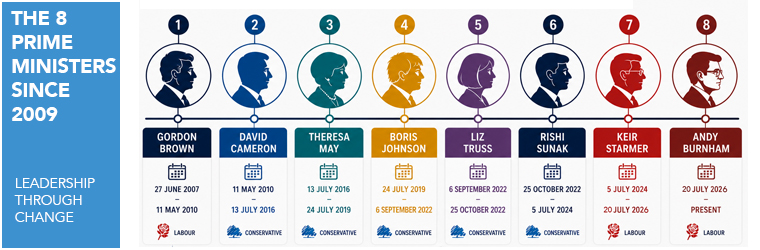
By the time I was her age, I had seen just 4 PMs, from Harold Wilson through to Maggie Thatcher, and by the time my eighth PM was in office – nearing the end of his term – I had passed my 47th birthday!
All of which serves as an illustration of the phenomenon that is the revolving door at Number 10 that we have witnessed over the last decade or so. It remains to be seen if the latest incumbent as Prime Minister can get the UK back to the stability which tends to accompany longevity in office. We will cover later the initial market reaction to this latest ‘changing of the guard’.
Market update – July 2026
It’s fair to say that 2026 has been eventful. If we roll the clock back to the beginning of 2026, we had a relatively steady first two months of the year. But the conflict in Iran and subsequent oil shock – given the blockage of the Strait of Hormuz – dominated global financial markets during March and April. This caused increased volatility in both stock markets and government bonds due to the resulting uncertainty in energy prices and the risk that this uncertainty could stoke inflation.
The situation remains fluid, having initially calmed recently with a ceasefire in June. Sadly, we have since seen a resumption of strikes between Iran and the US. Effectively, the ceasefire is no longer, although it is to be hoped that a lasting peace process can be established – with the resultant reduction in tensions.
Oil prices, having reached as high as $115 a barrel at the height of hostilities, initially eased back to pre-conflict levels, close to $70 as the ceasefire was announced. This has since risen back to almost $90 as markets wonder which way the wind will blow and whether the Strait of Hormuz will be able to reopen permanently.
For now, uncertainty remains, which means volatility for oil prices, equities, and bonds will remain a factor. Markets have nevertheless proven resilient. They still expect sense to prevail and that Mr Trump will have to find a compromise – they believe his own stock market and bond investors will demand it.
Equities – defiant resilience continues
The stock market dips we saw in March and April have now been recovered as hope for lasting peace in the Middle East still prevails over a lasting return to full-blown hostilities. Indeed, some stock markets have pushed on to levels which are close to record highs.
Markets have been generally buoyed by the euphoria around artificial intelligence (AI) investments – notwithstanding a recent correction in some stocks – coupled with some strong fundamental earnings from many corporates in the US. “Magnificent Seven” firms, Amazon, Alphabet and Microsoft all demonstrated returns from their AI investments as their computing units benefited from the intense demand for AI infrastructure.
And in June, the world’s most valuable company, Nvidia, posted stronger-than-expected earnings with data centre revenue doubling in the last quarter. AI spending helped US GDP rise to 2% in the first quarter of 2026; however, May’s reading wasn’t enough to stop US public debt exceeding US annual GDP for the first time since World War Two, which is of some concern.
In summary, even though we have seen a modest pullback in some of the AI-related sectors in recent weeks, global equity markets have thus far largely shrugged off the shock of the Iran conflict, in a similar way to that of the effect of last year’s Trump tariffs, the effect of which also proved temporary. Markets clearly believe there will be a resolution, though they are not always right!
Looking at some of the geographical stock market sectors, we put some perspective on this by looking at the recovery over the last 3 months:
| Equity Region (Index) | Performance Q2 (1stApril – 30thJune) |
|---|---|
| US (S&P 500) | +14.8% |
| UK (FTSE-100) | +3.0% |
| Japan (Nikkei 225) | +38.0% |
| China (Shanghai SSE) | +5.2% |
| Europe (STOXX 50) | +13.6% |
Source: Yahoo Finance
The best performing equity region over the quarter was Japan, which posted a positive return of 38%, although in other Asian markets this hasn’t been replicated. China did not benefit from the AI bounce, although its equity market was steadily up over the same quarter (5.2%). Though Europe has delivered mixed economic data and inflation has been stickier than expected, the region delivered a healthy equity return of over 13% on the back of the de-escalation of tensions in the Middle East.
The US equity market was up nearly 15% in the second quarter as the AI trend dominated US market growth over the period. Having continued to deliver stronger-than-expected GDP numbers (+2.1% growth in the first quarter), Japanese equities bounced back, producing returns of 38% for the 2nd quarter. The UK equity market has delivered steady – if less spectacular returns than many other regions – 3% over the three months.
Readers of the April market update may recall we produced a graph aimed to put the swings of recent market volatility into some historic context, as we saw that the Iran conflict had caused a fall in March. The updated chart below again considers the performance of Global equities over the last 5 years and how they have reacted to, and recovered from ‘events’.
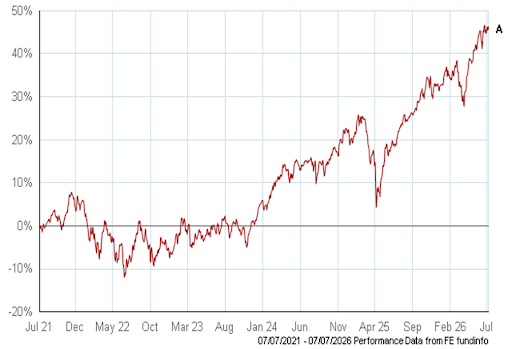
Source: FE Fundinfo. Chart A shows the performance of the Investment Association Global Equity Sector over the last 5 years (7.7.2021-7.7.2026), with notable events annotated. Bonds/Fixed Income – Volatility reducing, but inflation threat to interest rates remains
At the beginning of the Iran conflict, the value of most bond markets slipped back, as yields on Bonds (the interest Governments must pay on their borrowings) increased significantly.
In the UK, the cost of borrowing for the Government on 10-year Gilts was around 4.5%. It reached almost 5.2% at one stage but by the end of June was back around 4.7%. Across the globe, in fact, over the last quarter, yields have broadly moved back lower (resulting in bond values rising) as concerns that the recent surge in oil prices would feed into higher inflation have abated somewhat.
Overall, fixed income has delivered positive returns over the last quarter, with the reduction in the conflict (albeit temporary) in the Middle East being the biggest factor. This saw the price of oil drop, which relieved some inflationary pressures.
The memorandum of understanding remains in place between the US and Iran, and despite hostilities resuming, hasn’t yet been formally rescinded. It is to be hoped that both parties step back from the brink and that we do finally see an end to the conflict and the lasting resumption of oil exports via the Strait of Hormuz. If we do, this could reduce inflationary pressures and improve growth prospects for the rest of 2026.
It’s important to stress that we have yet to see the impact of the conflict filter through in the shape of higher inflation, as there is a delay in this feeding through to the official figures. In the UK, expectations have shifted from Bank of England interest rate cuts (before the Iran conflict) to the possibility of the Bank of England needing to hike rates this year.
The Burnham effect
It’s very early days – 2 days at the time of writing! And thus far we have seen some major changes in Cabinet, the most significant being the removal of Rachel Reeves as Chancellor and the appointment of John Healey in her place.
It remains to be seen how things will pan out as there is understandably little yet in the way of policy coming out of Numbers 10 & 11. But Burnham and Healey have inherited a UK borrowing situation which isn’t in fantastic shape, with public sector debt knocking on the door of £3 trillion. The figures from the Office for Budget Responsibility have also just been released for the latest quarter, which shows that Rachel Reeves borrowed £2.7bn more than forecast.
So, it’s a tricky time to be taking the reins. Market reaction has been fairly neutral in the UK stock market, but in the Bond market, the cost of interest on UK government borrowing has risen. The interest charged on 10-year gilts has passed 5% again (CNBC 20th July 2026), having been at 4.7% just weeks ago. However, other countries’ borrowing costs have been similarly impacted. This is likely a reaction to the prolongation of events in the Middle East (and worries over the return of inflation) rather than being an initial verdict on Burnham’s Premiership.
Summary
Despite the recently agreed memorandum, the resumption of hostilities in Iran has increased market uncertainty and continues to warrant close monitoring. History suggests that markets often stabilise once the initial uncertainty begins to fade, and although there may be more bumps in the road – this is already borne out by the ‘events’ chart above.
Geopolitical uncertainty therefore remains an issue to be aware of, and managing risk by adopting a broad-based approach in portfolio composition will, as ever, play an important role.
Legal & Medical portfolio positioning
Given the recent escalation in the Middle East, the Risk Barometer has dropped slightly into the Amber zone, indicating that portfolios should remain neutral to positive in equity exposure within their permitted range.
We remain somewhat underweight in US stocks, and tech stocks in particular, and – whilst equity content remains similar – continue to be overweight in other global markets including the UK and Japan, where we see better value.
In the Bond / Fixed interest space, we continue to hold a higher degree of shorter-dated bonds, which are much less susceptible to inflation and potential interest-rate changes. We plan to continue in this vein to provide a counterbalance to the equity market risk.
Our portfolios continue to hold a good mix of different asset classes, taking a diversified approach to investing, to smooth the investment journey for investors.
Whilst risk to the downside always remains, the portfolios are constructed to weather these risks whilst capturing the upside. Our portfolios continue to hold a good mix of different asset classes, taking a diversified approach to investing, to smooth the investment journey for investors.
- Equity holdings in the portfolios are designed to deliver long-term growth.
- Fixed income holdings focus on high-quality businesses that are close to maturity, offering an attractive return and lower risk.
- Alternatives such as infrastructure and commodities (such as Gold and Silver) provide additional diversification benefits through exposure to steady long-term cash flows, which reflect the effects of economic growth and inflation.
If you have any questions or concerns regarding your investment portfolio, or just need a chat to discuss the topics in this article, please do get in touch.
This article should not be interpreted as specific advice; as always, we would urge you to contact one of our specialist advisers who will look at your own circumstances before advising.