It’s not often a decades-old quote perfectly captures today’s markets, but this one managed exactly that: ‘Events, dear boy, events’. Plus, isn’t it nice to have a picture of a politician that isn’t Donald Trump, or any of the current crop, to be fair? So, whose quote is it? And why is he here?
Award yourself 50p (or should that be Ten Bob, given the vintage?) – if you spotted it’s the late Harold Macmillan, one-time Prime Minister of the UK in the post-war years. When he was once asked what the greatest challenge was for a statesman, he replied: ‘Events, dear boy, events’. The same is true for most leaders, organisations, and markets because we have had some ‘events’, to say the least.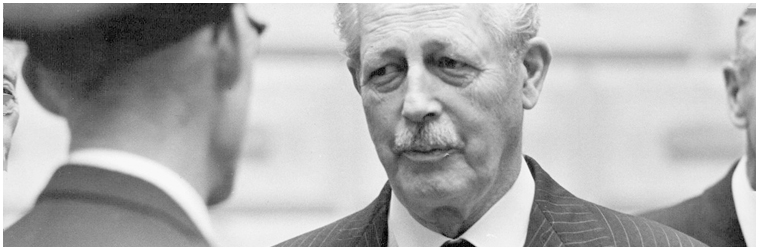
From stability to volatility
After a fairly steady start to 2026 for markets, volatility has returned. It feels a lot like tariff-gate in March/April 2025, when we saw fairly wild fluctuations brought on by the decisions of a President acting unpredictably and irrationally; only instead of starting a trade war, we now have an actual war.
Equity markets
Since the beginning of March, the escalation of the Middle East conflict has, of course, dominated global economic news. This has driven volatility in both stock markets and government bonds, as uncertainty around energy prices and the risk that this will feed into increased costs on goods and transport will, in turn, stoke inflation. The situation is fluid, and whilst it is hoped that a lasting peace process can be established, which would reduce tensions and free up trade. Until then, volatility is likely to continue.
Having started the year strongly, most asset classes were negatively impacted in March, with global equity markets bearing the brunt of volatility. Although the selloff was relatively muted in comparison to moves experienced following Trump’s ‘Liberation Day’ tariff announcements a year ago.
Global equity markets fell on average by 6.3% throughout March, although regional returns varied. Countries/regions more exposed to energy exports from the Gulf were more negatively impacted, given the spike in oil prices. This was evident in examining the monthly returns for regions such as Japan, which were harder hit, whereas the downturn in the US market, given that the country is a net oil/gas exporter and benefited from a rally in the US dollar, was shallower. While recent performance has been disappointing, notably global equity returns have been relatively muted year-to-date, with many regions in positive territory.
Looking at some of the geographical sectors, we put some perspective on this by looking at year-to-date performance for the US, UK, and Japan compared to March in isolation.
| Equity Region (Index) | Performance month of March 2026 | Performance Year-to-Date (to14 April 2026) |
|---|---|---|
| US (S&P 500) | -5.1% | +1.8% |
| UK (FTSE-100) | -3.9% | +6.8% |
| Japan (Nikkei 225) | -12.6% | +15.4% |
Source: Yahoo Finance
In fact, it is helpful to look back over a longer period to put this recent market volatility into perspective. The chart below looks at the performance of Global Equities over the last 5 years and how they have been impacted by ‘events’. It also illustrates how markets subsequently recovered. This is a theme of Legal & Medical’s Guide to Investment, which is a reassuring read in uncertain times.
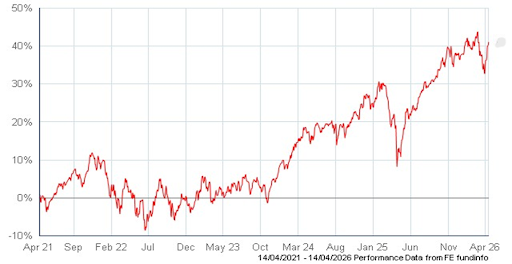
Source: FE Fundinfo. The chart shows the performance of the Investment Association Global Equity Sector over the last 5 years, with notable events annotated
What about Bonds and the cost of borrowing?
The value of most bond markets weakened following the start of hostilities, with government bond yields rising (resulting in bond prices finishing lower) over concerns that the recent surge in oil prices would feed into higher inflation.
This was particularly notable to us in the UK, where expectations have shifted from Bank of England interest rate cuts (before the Iran conflict) to the possibility that the Bank of England may need to hike rates again if inflation becomes a threat. This shift has already fed into mortgage rates, which look forward and ‘price in’ potential interest rate changes – to increase, an impact which could become more lasting if the Middle East situation persists.
The UK’s reliance on imported energy leaves it particularly exposed to these pressures, contributing to falling gilt prices and a higher cost of borrowing. Happily, our portfolios’ exposure to shorter-dated, investment-grade bonds has been a helpful factor, as, although these too have fallen a little, the drawdowns have been much more muted.
Alternative asset space – Gold isn’t always glittery
Most alternative asset classes also struggled, except for oil, which has obviously spiked from its pre-Iran war levels. Precious metals have also pulled back from record highs, and we have seen weakness across other asset classes, such as infrastructure and property, given the heightened geopolitical uncertainty.
Legal & Medical Portfolio Positioning
Given the recent escalation in the Middle East, the Risk Barometer has softened slightly; however, it remains in the Green Zone, indicating that the portfolios should remain neutral to positive for equity exposure within their permitted range.
We remain somewhat underweight in US stocks, and tech stocks in particular; whilst equity content remains similar, we have rotated some funds in the portfolios from the US to other global markets, including the UK and Japan, where we see better value.
In the Bond / Fixed interest space, we continue to hold a higher degree of shorter-dated bonds, which are much less susceptible to inflation and potential interest-rate changes. We plan to continue in this vein to provide a counterbalance to the equity market risk.
Our portfolios continue to hold a good mix of different asset classes, taking a diversified approach to investing, to smooth the investment journey for investors.
Whilst downside risk always remains, the portfolios are constructed to weather these risks whilst capturing the upside. Our portfolios continue to hold a good mix of different asset classes, taking a diversified approach to investing, to smooth the investment journey for investors.
- Equities:
Equity holdings in the portfolios are designed to deliver long-term growth. - Fixed income:
Fixed income holdings focus on high-quality businesses which are close to maturity. These tend to offer an attractive level of return and experience a lower level of risk. - Diversification:
Alternatives such as infrastructure and commodities (such as Gold and Silver) provide additional diversification benefits through exposure to steady long-term cash flows, which reflect the effects of economic growth and inflation.
Summary
Despite the recently agreed ceasefire, the situation involving Iran has increased market uncertainty and continues to warrant close monitoring. History suggests that markets often stabilise once the initial uncertainty begins to fade, and although there may be more bumps in the road, this is already borne out by the ‘events’ chart above.
This pattern was visible following the outbreak of the Russia-Ukraine war and during earlier conflicts such as the Iraq and Gulf wars. While initial reactions were often significant, markets typically recovered as the situation became clearer. From our perspective, it’s important to avoid making knee-jerk decisions and instead focus on diversification to help weather any volatility.
While potential geopolitical uncertainty remains an issue, the ability to manage risk by adopting a broad-based approach will continue to play an important role.
If you would like to discuss your portfolio or any aspects covered in this article, please do get in touch. This is not personal advice. If you are unsure of the suitability of an investment for your circumstances, please seek specialist advice.