For years, the exit plan from a private practice for many consultants has been simple: leave the profits in the company, close it down when you retire, and hope to pay just 18% tax on the way out. The Budget on 28th October, 2026 has made that plan more expensive.
From April 6th, 2027, the lifetime limit for Business Asset Disposal Relief (BADR) halves, from £1 million to £500,000.1,2
Even if you’ve never thought of your practice as something to sell, this change may well affect you. Meaning, BADR isn’t only for doctors, dentists and consultants selling a business. It also applies to many who simply want to close their company.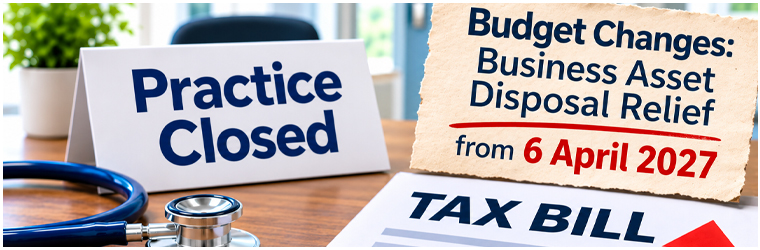
At a glance
- BADR cuts Capital Gains Tax on qualifying gains to 18%, instead of 24%.
- From April, 6th 2027 the lifetime limit falls from £1 million to £500,000.
- It can apply when you close your company, not just when you sell it.
- A large cash balance could stop your company qualifying at all.
- Pensions, spreading dividends and a spouse’s own limit may help, but only with the right advice.
What is BADR?
BADR (once called Entrepreneurs’ Relief) lowers the Capital Gains Tax (CGT) on qualifying gains to 18%, rather than the 24% a higher-rate taxpayer would normally pay.3,4
The limit is a lifetime one. It applies to each person, not each sale, and it isn’t an annual allowance.5
Not selling? Closing down can qualify too
Plenty of consultants never sell their private practice. Often there’s nothing to sell except you! When you retire from private work, the company simply closes.
Closing formally. If the company is wound up formally (usually through a members’ voluntary liquidation), the money paid out to shareholders can be treated as capital, and BADR can apply if the conditions are met.6
For shares, all of these must have been true for at least two years:7
- You held at least 5% of the shares and voting rights.
- You were an officer or employee of the company.
- The company was mainly a trading company.
If the company has already stopped trading, you can still qualify as long as the disposal happens within three years.7
Closing informally. Simply striking the company off is different. Only up to £25,000 can be treated as capital that way, so speak to your accountant before choosing this route.6
Sole traders and partners who close down can claim BADR, as long as the business assets are disposed of within three years of the business ceasing.5,7
The cash pile problem
It’s a familiar story. A consultant’s private practice company builds up a healthy bank balance because taking it all out as dividends would mean a higher tax bill. The plan is to wind the company up one day and pay 18% instead.
That plan now has two catches.
Catch 1: the limit is shrinking
Here’s how the tax on a £1 million gain could change:
Our own sum, using the 18% and 24% rates above. It assumes a higher-rate taxpayer who has never claimed BADR before and whose whole gain qualifies. It ignores the annual exempt amount and other reliefs.
Catch 2: too much cash can count against you
To qualify, the company must not have non-trading activities “to a substantial extent”. HMRC looks at things like the value of non-trading assets compared with total assets, and uses 20% as a practical guide.8
Whether a big cash balance counts depends on the facts. As we’ve said before, the 18% rate doesn’t automatically mean built-up cash comes out at 18%4. Check with your accountant before relying on BADR.
What are people doing instead?
With less relief available, many company owners are rethinking how they draw money out. The most common options are:
- Spreading dividends over several years to make the most of lower tax bands each year. Our dental associates article sets out the current dividend rates.4
- Employer pension contributions. Contributions made by your company can be a deductible business expense, provided your overall pay package is reasonable for the work you do.9 For members of the NHS pension scheme, the annual allowance is the catch. It’s £60,000, with a taper for higher earners, and your NHS pension growth counts towards it, as well as any personal pension contributions.10 Check your NHS pension savings statement before your company pays anything in, and check whether you have unused annual allowance from the previous three years that you may be able to use.
- Winding up with BADR within the new £500,000 limit.
The right mix is a job for your accountant and specialist financial adviser working together.
Could two directors get you back to £1 million?
Possibly, but being a director isn’t enough on its own.
Each person has their own lifetime limit, and HMRC confirms that spouses and civil partners “may each make a claim”.5 So, if you and your spouse each qualify, you could each get relief on up to £500,000 of gains: £1 million between you.
But each of you must meet all the conditions for at least two years before the disposal:7
- At least 5% of the shares and voting rights.
- The matching rights to profits or proceeds.
- Being an officer or employee.
Shares held jointly are split between you. So a small joint holding may leave neither of you with 5%.5
Moving shares to your spouse doesn’t normally trigger CGT.11 But a spouse brought in now won’t meet the two-year test before April 2027, and other tax rules can apply when shares change hands. Please don’t do it without advice from your accountant.
Leaving private practice but keeping your NHS work?
There’s an anti-avoidance rule designed to stop people winding up a company, taking the cash as capital and then carrying on as before. If it applies, the payout is taxed as income instead.
It only applies if all of its conditions are met. One of them is that, within two years of the payout, you carry on, or are “involved with”, the same or a similar trade.12 If you genuinely stop, that condition shouldn’t be met.
The catch is that HMRC reads “involved with” widely, and its examples include working as an employee of a similar business.13 HMRC’s guidance doesn’t directly say whether continuing NHS work after closing a private practice company counts, so take individual advice before you wind up.
Four things to do now
- Ask your accountant whether your company still counts as a trading company.
- Check your BADR history, and your spouse’s if they hold shares.
- Look at your pension position before your company makes any employer contributions.
- Decide your exit timetable on its merits, not just because of the April 2027 deadline. Announced anti-avoidance rules mean signing a deal early won’t necessarily lock in the old limit.14
Final thoughts
The new limit doesn’t make closing your company a bad idea. It just means the “leave the cash in and wind it up later” plan needs a fresh look, ideally well before you stop private practice for good.
If you’d like to talk through your options as part of your wider retirement plans, please contact one of our specialist financial advisers.
Is your company sitting on cash you’re not sure how to draw out? Let us know by adding a comment below.
This article is based on our understanding of the Budget announcements of 28/10/2026, which are not yet law and may change. It does not constitute personal advice. Tax treatment depends on your individual circumstances and may change in future. The Financial Conduct Authority does not regulate tax advice. Please speak to your accountant or tax adviser about your own position. The value of pension investments and the income from them can fall as well as rise.
References
1 HM Revenue & Customs
2 HM Treasury
3 GOV.UK
4 Legal & Medical
5 HM Revenue & Customs
6 HMRC Capital Gains Manual
7 GOV.UK
8 HMRC Capital Gains Manual
9 HMRC Business Income Manual
10 Royal London
11 GOV.UK
12 HMRC Company Taxation Manual
13 HMRC Company Taxation Manual
14 Alexander & Co.