Have you ever wondered what the best-performing investment sector is every year? Hands up anyone who thinks they can predict it. Not many hands I see! I’m not surprised.
If it feels like the investment world has been unusually lively so far this year, you’re not alone. The opening weeks of 2026 have delivered a steady stream of market‑moving headlines. Economic data, political developments, shifting interest‑rate expectations, corporate surprises, you name it, it has probably influenced markets already. Even by the standards of global investing, where “normal” is usually a moving target, the pace has been brisk.
Making sense of market behaviour
With so much happening, it felt like the right moment to revisit one of our favourite ways of making sense of market behaviour: the sector “patchwork quilt”. Instead of grouping companies by geography, the quilt sorts them by what they actually do.
Each column represents a year, each colour a sector, and the ranking runs from best performer at the top to worst at the bottom. Normally, we update this once a year, but given the flurry of activity, we decided to dust it off early.
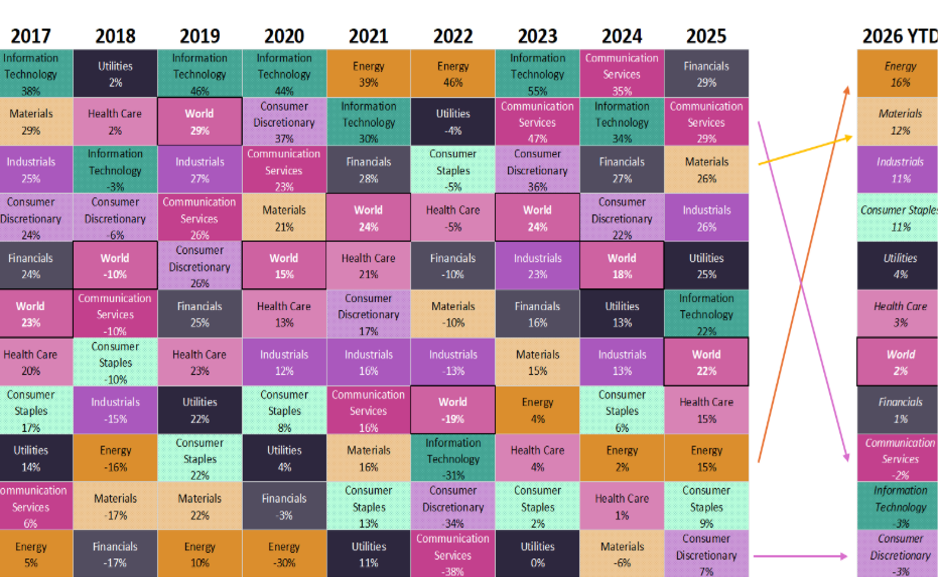
Source: 7IM and FactSet, based on MSCI World Sector indices (USD). Feb 2026.
How to read the patchwork quilt
Before diving into what it shows, here’s a quick explanation of how to read it. Each column is a calendar year. The top of the column is the strongest performing sector, the bottom the weakest. Each colour corresponds to a different sector. The data comes from 7IM and FactSet, using MSCI World Sectors in US dollars.
Once you step back and look at the ‘quilt’, three themes stand out, and they tell an important story about why diversification remains so essential.
There are no magic rules
Despite what the interest or Sunday papers might tell you, there are no magic rules.
Investing is full of tempting “rules of thumb”. Run the winners. Buy the laggards. Tech always wins. Energy always loses. There’s always a simple pattern if you squint hard enough.
The problem is that these rules only work in hindsight. They contradict each other, and they fall apart the moment you try to apply them consistently.
This year is a perfect example. Energy stocks, which languished at the bottom of the table not long ago, have surged to the top. Meanwhile, consumer discretionary companies are a broad group that includes Amazon, Toyota, Louis Vuitton and many others. They have remained stubbornly weak. Materials have continued their strong run, but Communication Services, last year’s standout, has slipped back.
If there really were a magic formula, we’d all be retired on a tropical beach somewhere. Markets simply don’t reward simplistic thinking. They reward patience, discipline, time and a willingness to accept that leadership rotates. What worked last year may not work this year, and what works this year may not work next.
In the words of Madonna…we’re living in a material world
One of the most striking features of the quilt this year is the dominance of sectors tied to the physical world. Energy producers, miners, chemical companies and industrial equipment makers have all been among the strongest performers. In short, drillers, diggers and defence have outpaced digital.
Why? Investors are reassessing where the real bottlenecks in the global economy lie. After years of focusing on software, platforms and intangible assets, attention has swung back to the basics: energy security, raw materials, infrastructure, manufacturing capacity and supply‑chain resilience. Governments are spending heavily in these areas, some of it strategic, some political, some simply overdue and markets are responding.
This doesn’t mean technology is irrelevant – far from it. But it does highlight how quickly the narrative can shift. The sectors that dominated the last decade aren’t guaranteed to dominate the next. Markets evolve, and portfolios need to evolve with them.
Even the “stable” bits look volatile right now
Utilities are usually the tortoises of the market. They provide essential services, households pay their bills, and revenues tend to be steady. These companies rarely produce blockbuster products or dramatic surprises. They simply get on with the job.
But when everything else is swinging wildly from hero to villain, even the quiet sectors get jostled around. In a year when investors are constantly reassessing inflation, interest rates, geopolitical risks and supply‑chain pressures, even the traditionally stable parts of the market can appear more volatile than usual.
This is an important reminder: stability is relative. When the rest of the market won’t sit still, even the calmest sectors can look chaotic.
What does this mean for you?
The quilt makes one thing abundantly clear: picking a single corner and hoping it behaves is not a strategy. Markets rotate, leadership changes. What’s hot one year can be ice‑cold the next. And the sectors that look unstoppable today can fall out of favour tomorrow.
This is exactly why diversification remains the most powerful tool available to long‑term investors. It may not be the most exciting concept, but it is consistently effective. A well‑diversified portfolio doesn’t rely on guessing which sector will shine next. Instead, it spreads exposure across the entire quilt, capturing the winners while cushioning the impact of the laggards.
In other words, rather than trying to predict which patch will be on top next year, it’s far wiser to wrap yourself in the whole quilt.
If you’d like to discuss how your portfolio is positioned or whether any adjustments make sense in light of recent market moves, we’re always here.
Please note: This article was written before the recent developments in the Middle East, which are likely to change the narrative for 2026 substantially.
Please be aware that the value of investments linked to the stock market may rise or fall depending on market conditions and that you may not always recoup your initial investment. Past performance should not be seen as an indication of future returns.
Did you guess the correct answer? Let us know by adding a comment below.